Ever wondered why pool water stays crystal clear for months, while water left sitting in a bucket for just a few days turns murky and smelly? There's no magic involved. The answer comes down to chemical balance maintained on a regular basis.
Proper pool maintenance is more than just filtering out physical debris like leaves and dust. It also involves controlling the microbiological ecosystem in the water, things like bacteria, viruses, algae, and other invisible microorganisms that can directly affect swimmers' health.
This article breaks down the most common "pool chemicals" used in pool maintenance, covering what they do, how they work, and the safety precautions you need to know before using them.
Types of Chemicals Used in Swimming Pools
Broadly speaking, pool chemicals are grouped by their specific function. Each group plays a different, complementary role, kind of like a team working together to keep water quality at its best. Here's a quick rundown of the chemical types used in pools.
- Germ and Bacteria Killing Chemicals
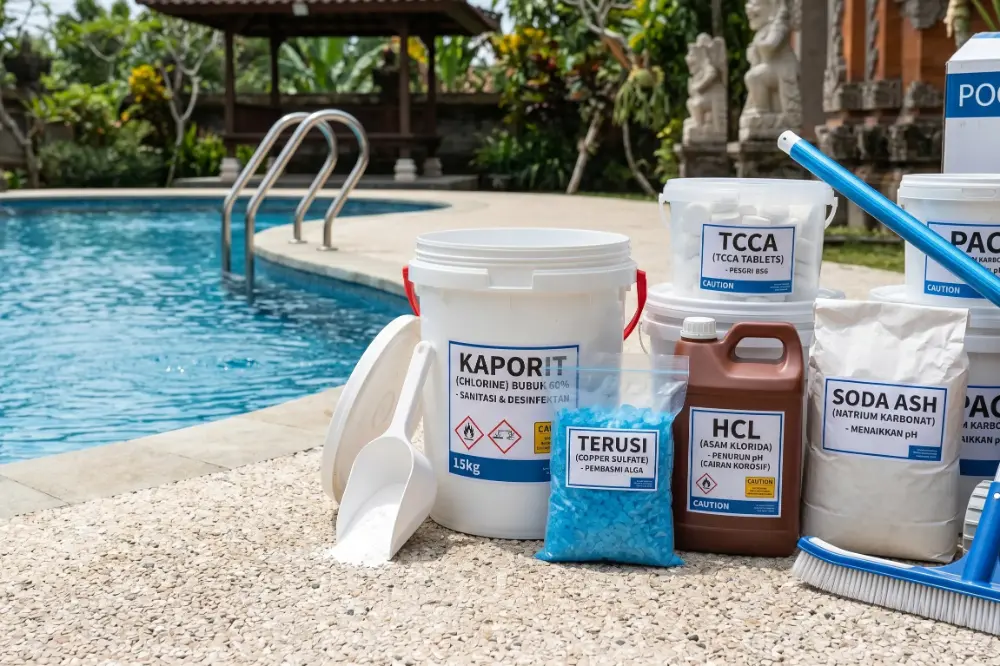
This is the most fundamental chemical in pool maintenance. The most commonly used one is chlorine (calcium hypochlorite), whose main job is to kill bacteria, viruses, and germs while also preventing algae growth that makes pool walls slippery and water turn green.
Here's an interesting fact many people get wrong about that strong chlorine smell. That sharp smell you often notice at public pools isn't actually a sign of too much chlorine. It's the opposite. That smell shows up when chlorine is working hard to break down organic contaminants like sweat and urine, creating a compound called chloramines. The stronger the smell, the more it signals a need for fresh chlorine and better air circulation. - pH Balancing Chemicals
An ideal pool pH of 7.2 to 7.6 isn't random. That range sits close to the natural pH of human tears, which is why it feels comfortable on your eyes and skin. Here's the key thing to remember. Chlorine only works at full effectiveness when the water's pH stays within that range. If the pH drifts off, the chlorine you add becomes far less effective.
Two situations can happen here, and each one needs a different fix.
- Soda Ash (Sodium Carbonate)
Used when the water's pH is too acidic (below 7.2). Overly acidic water doesn't just sting your eyes and irritate your skin, it's also corrosive to pump equipment and metal pool components. Soda ash raises the pH back to a safe level. - Hydrochloric Acid (HCl) or Dry Acid (Sodium Bisulfate)
Used when the water's pH is too alkaline (above 7.6). Overly alkaline water often looks cloudy or hazy even with chlorine already added, and over time it leaves calcium scale on tiles or pool walls.
- Soda Ash (Sodium Carbonate)
- Sediment Clarifying Chemicals
Picture a pool after heavy rain, or one that hasn't been maintained in a while, the water can turn completely murky. Pool filters can catch debris, but some particles are simply too small for a standard filter to trap. That's where sediment clarifying chemicals come in.
- PAC (Poly Aluminium Chloride)
This chemical binds together the microscopic particles floating freely in the water, forming heavier clumps called floc that sink to the pool floor. Once settled, this sediment can be removed by vacuuming. - Alum (Aluminium Sulfate)
This is the traditional alternative to PAC, serving a similar function of clarifying water by settling fine particles. However, in modern pool care, alum use has declined since PAC is considered more efficient and faster acting.
- PAC (Poly Aluminium Chloride)
- Algae Prevention and Coloring Chemicals
This chemical plays a fairly unique dual role. The most commonly used one is copper sulfate, which works as an algaecide (killing off algae spores before they can grow) while also being responsible for that fresh, clear blue pool water color.
Important warning:
Copper sulfate dosage needs to be measured very precisely. Used in excess, its copper content can cause unwanted problems. Swimmers' hair (especially blonde or color treated hair) can turn greenish, and pool tiles can develop dark stains that are difficult to remove.
Safety Tips and Rules
Pool chemicals are safe when used correctly, but a single wrong step can lead to serious consequences. Before adding any chemical to your pool, there are two basic rules you must follow.
- Never Mix Chemicals Directly
This isn't just a suggestion, it's a serious warning. Mixing chlorine directly with HCl (hydrochloric acid) in the same container can produce highly toxic, potentially lethal chlorine gas. Always dissolve each chemical separately, and never combine them in a single bucket. - Recommended Chemical Application Method
Before adding any chemical to the pool, it needs to be dissolved first in a bucket of clean water. Pouring water into concentrated chemicals can trigger a dangerous heat reaction. That's why you should always fill the bucket with water first, then add the chemical, never the other way around.
Once the chemical has dissolved or mixed thoroughly in the bucket, pour it evenly around the pool's edge, or adjust based on your circulation system (skimmer or overflow). These two systems have different water flow patterns, so the optimal application point differs between them.
Conclusion and Recommendation
Pool maintenance isn't just about keeping the water clear. It's also about maintaining chemical balance to keep it safe for health and to protect the pool structure. Every chemical plays a specific role, so it has to be used in the right dose and for the right purpose.
Check the pH and overall water quality regularly, at least once a week. Use each chemical for its intended purpose, and never mix chemicals directly. If you don't have the time or experience for this, leave your pool maintenance to the professionals. Contact Bali Arsitek for a more practical and safer consultation and handling process.