How do you build a swimming pool at home that is not only beautiful, but also easy to maintain and functional? When designing an efficient and aesthetic swimming pool in a residential environment, one crucial decision is choosing the right water circulation system. The use of a skimmer or overflow system will greatly affect the quality of maintenance, operational efficiency, and long-term comfort of the swimming pool.
This article not only helps you understand both circulation systems, but also provides practical guidance for choosing the system that best suits your lifestyle, aesthetics, and budget.
Differences in Aesthetic Aspects
- Water Line Look
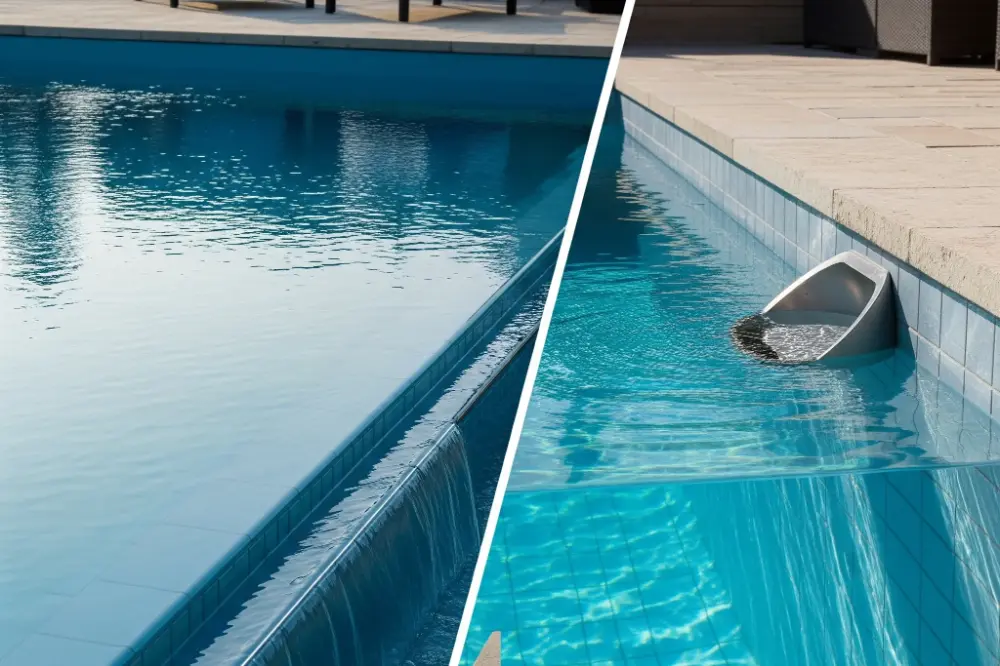
Visually, there is a striking difference between swimming pools with skimmer and overflow circulation systems. In terms of aesthetics, swimming pools with overflow systems have a more elegant and luxurious appearance than skimmer systems. This difference can be seen on the surface of the pool, where overflow pools have a surface that is flush with the edge of the pool, creating an infinity effect that gives a modern and exclusive feel. In contrast, skimmer pools have a water surface that is lower than the edge of the pool, so that the waterline is clearly visible and gives a simple and functional impression. - Integration with Landscape Design
The integration of skimmer and overflow systems with the surrounding environment greatly influences the character of the landscape and the spatial experience. Overflow systems create a water surface that is flush with the edge of the pool, creating a visual effect that blends in with the horizon or open landscape. This system is suitable for locations with expansive views, such as rooftops, resort areas, or cliff edges, where overflowing water can be used as a reflective and sensory element.
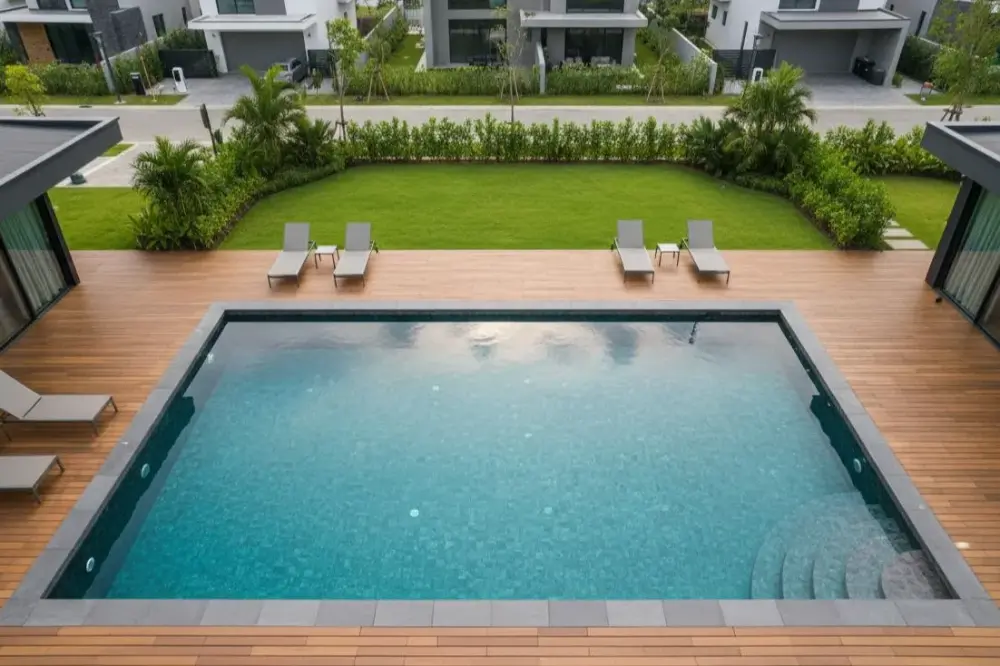
In contrast, skimmer systems with a water surface lower than the edge of the pool tend to blend in functionally with gardens or green areas. This allows for the use of elements such as paving, edge vegetation, and traditional ornaments without requiring precise elevation.
Both systems have strong integration potential, but the choice must still be tailored to the characteristics of the land, architectural style, and the desired atmosphere of the space.
Considerations Regarding Initial Production Costs and Long-Term Costs
- Initial Construction Costs
Overflow systems are significantly more expensive than skimmer systems. This is because overflows require more complex civil engineering work, including the construction of a balancing tank and gutters around the pool. In contrast, skimmers are more budget-friendly because their construction is much simpler and does not require a balancing tank or gutters. - Regular Maintenance Costs
Although overflow systems are more effective at keeping the water surface clean, the pump must operate more frequently to maintain overflow flow, resulting in higher electricity consumption. Meanwhile, skimmer systems may require more frequent manual cleaning, but they are more energy efficient because the volume of water circulated is smaller and the circulation path is simpler.
Efficiency and Water Quality
- Water Surface Cleaning
The overflow system has high cleaning efficiency because the surface water of the pool continuously overflows into the gutter channel, so that floating debris is immediately carried to the filtration system. Unlike overflow, the skimmer system sucks water from the surface of the pool through several boxes attached to the pool wall. The water that enters the skimmer carries light debris such as hair, leaves, insects, and oil, which is then filtered in a basket and sent to the filtration system. However, because the skimmer only draws water from a limited area around it, the surface cleaning efficiency tends to be lower. This can cause a “dead zone” to form in the corners of the pool where debris can settle and not circulate optimally. - Chemical Stability
The balancing tank in the overflow system functions as both a hydraulic buffer and a chemical stabilizer. With its large capacity, chemical fluctuations caused by rain, intensive use, or chemical injection can be naturally mitigated. This is because the concentration of additives is more evenly distributed and does not affect the main water in the pool. This process creates a homogeneous mixing zone before the water enters filtration, thereby increasing disinfection efficiency and minimizing the risk of irritation or damage.
Which is Better?
If you have a limited budget, limited space, and practical maintenance needs, you can use a skimmer system for your pool construction. With a more compact design, skimmer systems are still able to maintain pool water cleanliness effectively. This can make them an efficient and economical solution for pool owners who prioritize functionality and ease of operation. If budget is not an issue for those who want a luxurious and modern swimming pool with a large enough area, then an overflow system is an ideal choice. Its elegant design without visible water edges gives a premium and highly aesthetic impression to the entire surface of the swimming pool. In addition, this system offers superior water circulation efficiency that can produce stable, clean, and safe water quality. With these advantages, the overflow system is the ideal solution for swimming pool projects that prioritize performance and luxury.
If you want to build a swimming pool on a budget but still want flexibility in choosing a circulation system, whether skimmer or overflow, Bali Arsitek's minimalist swimming pool construction services are the right choice. With a functional and aesthetic approach, Bali Arsitek offers solutions that allow you to get the best look and performance. This flexibility gives you complete control over the style and system that suits your needs.
Conclusion
Both of the above circulation systems, skimmer and overflow, have their own advantages and disadvantages. It all depends on the priorities you want to achieve, whether it be aesthetics, efficiency, land area, or a suitable budget. The best choice is the system that best suits your specific dreams and needs. Before making a final decision, it is highly recommended to discuss these criteria with an experienced pool contractor to ensure the chosen solution is truly optimal.
By understanding these differences, you are one step closer to having a swimming pool that is not only beautiful, but also perfect for you.