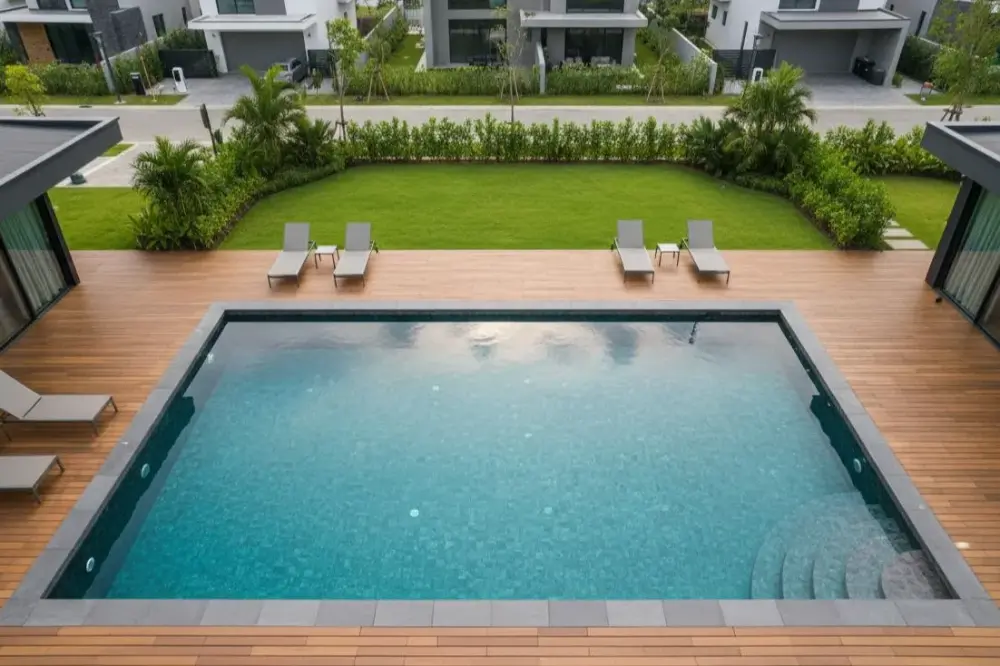
Imagine a swimming pool as the human body, and the water as blood. The water circulation system, consisting of a pump, filter, skimmer, and drainage, functions like the circulatory system that keeps the body alive, clean, and balanced. If one component fails, such as the pump stopping or the filter becoming clogged, the pool will become “sick” (the water becomes cloudy, smelly, and unsafe). Maintaining this system is like maintaining the health of the heart and kidneys in the human body.
Therefore, this water circulation system is a vital component of swimming pool construction. Two types of circulation systems commonly used are skimmer systems and overflow systems. Let's examine the differences, advantages, and disadvantages of these two water circulation systems.
Understanding the Skimmer System (Traditional System)
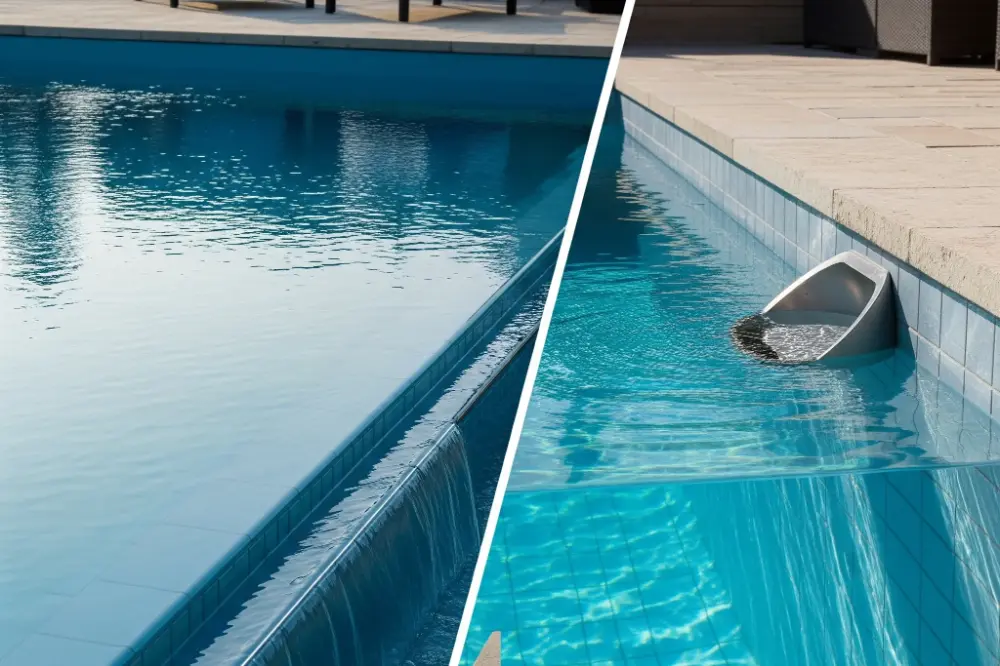
A skimmer system is a swimming pool water circulation method that uses a device called a skimmer box. The skimmer box is used to suck water from the surface of the pool. It is usually installed on the pool wall, just below the surface of the swimming pool water. This device functions as the main inlet for water to enter the filtration system.
The skimmer system works by drawing surface water, which then enters through a flap (weir). Debris such as leaves, insects, and oil will be trapped in the skimmer basket. The water that enters will then be pumped to the filter, and after being filtered, the clean water will be returned to the pool through a return jet.
Advantages:
- More Economical Construction Costs
No overflow channels or balancing tanks are required, resulting in savings in materials and space. - Easy Maintenance
Equipped with a dirt trap basket that is easy to clean without opening the main system. - Flexible for Various Pool Designs
Can be applied to various pool shapes without requiring a perimeter gutter or overflow design. - Operational Energy Savings
Lower pump and circulation systems, resulting in lower electricity consumption.
Disadvantages:
- Uneven Circulation
The skimmer only absorbs water in the area near the skimmer box, so debris in areas far from the skimmer takes longer to be absorbed. - Unaesthetic Look
The edge of the pool looks lower than the water surface, creating a clear boundary line. - Not Suitable for Large Pools
Circulation effectiveness decreases in large pools or pools with high usage intensity.
Understanding the Overflow System (Modern System)
The modern system, better known as overflow, is a swimming pool water circulation method where water is deliberately made to overflow from the edge of the pool into a gutter (special channel). After that, the water is drained into a balancing tank to be filtered and pumped back into the pool.
The overflow system works by keeping the water level in the pool level with the edge of the pool, so that when there is a disturbance (swimmer entering), the water immediately overflows into the channels surrounding the pool. The overflowing water is then collected in a balancing tank before entering the filtration system. After being filtered, the water is pumped back into the pool through the inlet pipe.
Kelebihan:
- High Aesthetics
The water surface and pool lip are aligned to create an elegant and modern look, suitable for infinity pool or zero edge designs. - Optimal Circulation
Water from the entire surface of the pool is thoroughly filtered. - Reduce Direct Evaporation
Closed systems help maintain water volume during hot weather and reduce refilling. - Healthier and Cleaner Water Quality
Surface water containing impurities flows directly into the gutter, allowing for maximum filtration and circulation.
Disadvantages:
- More Expensive
Requires more complex construction, including the creation of balancing tanks and gutters, which makes it more expensive. - Requires More Land
This system requires more land to build balancing tanks and overflow channels, making it less suitable for areas with limited land. - More Complex Maintenance
Requires routine cleaning of overflow channels and maintenance of balancing tanks. - Vulnerable to Leaks
Gutters and balancing tanks have points that are prone to leaks, which can cause structural damage if not properly addressed.
Which one is right for your needs?
The selection of the circulation system depends on the priorities and conditions of the project:
- If you prioritize efficiency, simplicity of maintenance, and a limited budget, a skimmer system is a practical and flexible choice. This system is suitable for private pools and narrow areas.
- If you are building a pool for a villa, resort, hotel, or luxury residence that demands high aesthetics and performance, an overflow system offers comprehensive circulation with a premium look.
Conclusion
From the two circulation systems for swimming pools above, it can be concluded that there is no universally superior system. The best system is the one that suits the purpose of use, location conditions, budget, and design priorities.
Every project has its own challenges and priorities; there is no single solution that fits all problems. Before building a swimming pool, be sure to consult with a professional pool contractor to choose the right system. The team of experts at Bali Arsitek is ready to assist you with technical analysis, design advice, and accurate cost estimates. Contact Bali Arsitek today and bring your dream swimming pool to reality with a targeted water circulation system.
That concludes our article on skimmer and overflow water circulation systems. We hope that with a proper understanding of these two systems, you are one step closer to having the swimming pool of your dreams.