Behind the crystal clear water of a swimming pool, requires a lengthy, labor-intensive, and meticulous excavation process. Excavation is an important initial step in the construction of a swimming pool. This process must be carried out in accordance with the predetermined design, in terms of shape, depth, and elevation.
Excavation of soil for swimming pools can be done using two main methods, namely manual power and heavy equipment such as excavators. The choice of method depends on the size of the swimming pool, land conditions, available access, and available budget.
This article will discuss the advantages, disadvantages, steps, and recommendations for both excavation methods. We will begin with a discussion of excavating a swimming pool using the manual method.
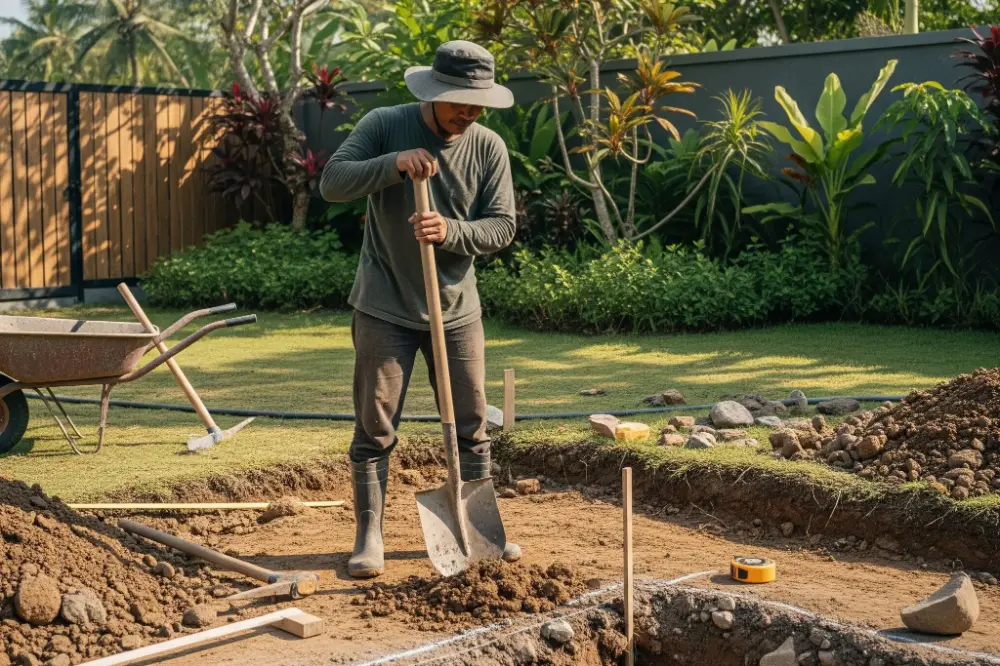
Excavating Swimming Pool Soil Using Manpower
Excavating a swimming pool using manual power is a traditional method that is still widely used, especially if the excavation site has limited access or soil conditions that require extra caution.
Advantages
- Manual excavation is suitable for use on narrow land that is difficult to reach with heavy equipment.
- This method allows workers to dig carefully, so that the shape of the excavation will look precise and follow design details such as curves or angles.
- Minimal vibration makes it safe for surrounding structures.
- No additional costs are required to rent heavy equipment, making it ideal for small-scale projects or private homes.
Disadvantages
- Requires more time, especially clay or rocky soil.
- Requires more workers with high stamina and skill.
- Higher risk of injury, requiring protective equipment and proper techniques.
Work Steps
The following are the steps for excavating a swimming pool using manual power:
- First, install the bowplank and mark the elevation and dimensions according to the design.
- Dig the soil gradually using a hoe, shovel, and crowbar. Ensure that the walls are perpendicular or sloped as needed.
- Move the excavated soil to the disposal site using a wheelbarrow.
- Tidy up the excavation shape according to the desired depth and slope using a stamper or tamping tool.
Excavation of Swimming Pool Soil Using Heavy Equipment
The use of heavy equipment in the process of excavating swimming pool soil tends to be more efficient and suitable for large-scale projects. Moreover, the location is easily accessible by heavy equipment.
Advantages
- Heavy equipment such as excavators or backhoes can complete excavation in a matter of hours or days. This method is faster than using humanpower, which can take weeks.
- They can handle various types of soil, such as clay, rocky, and sandy soil, more easily.
- They have a larger carrying capacity in a single operation, which is very efficient for swimming pools with significant depth and area.
Disadvantages
- Requires a sufficiently wide and stable access road to transport and operate heavy equipment in the swimming pool construction area.
- Bucket excavators have difficulty forming smooth curves or sharp angles in accordance with complex pool designs.
- The cost of rental, operators, fuel, and transportation can be more expensive than manual power, especially for small-scale projects.
Work Steps
- Ensure that the site has sufficient access for excavators to enter the project location.
- Operators excavate according to the bowplank boundaries and in accordance with the work plan.
- Use dump trucks or carts to transport excavated soil out of the site or level it at another location.
- After the heavy equipment has finished working, manually tidy up the edges and corners. Use a water level, theodolite, or laser level to ensure the precision of the ground.
Use of Combined Methods
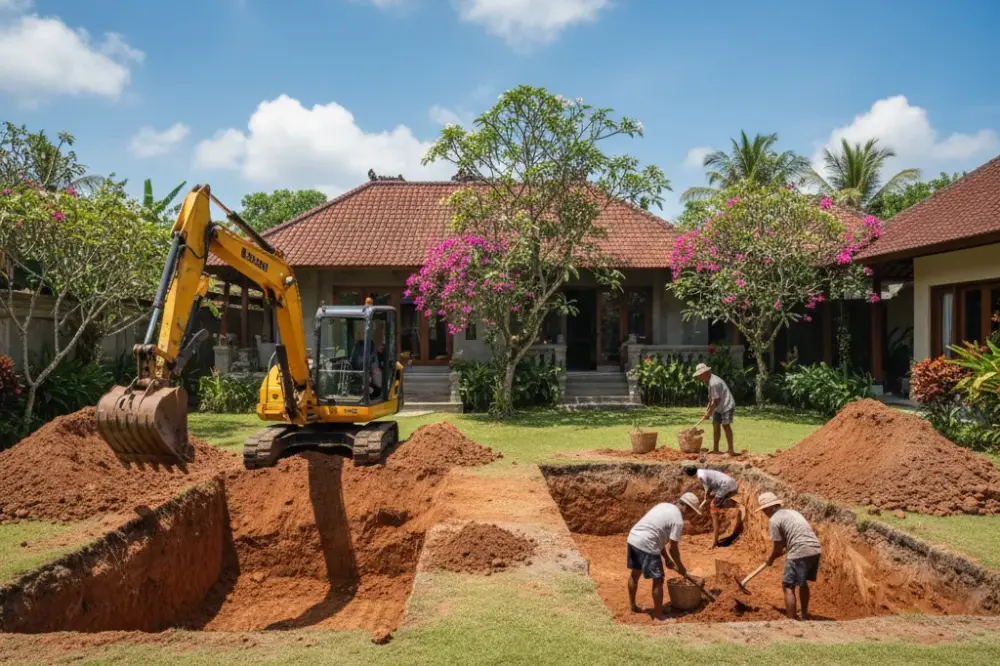
In many projects, a combination of excavators for main excavation and manpower for finishing work in narrow areas is used. This approach is considered effective because:
- Excavators accelerate large-scale excavation and are suitable for large areas with hard soil conditions.
- Manual power refines contours, angles, and elevations that cannot be reached by heavy equipment.
- Combined methods can save costs and time compared to using one method exclusively.
Important Notes
Before starting excavation using one of the above methods, there are several important things that must be considered to ensure that the project runs safely, efficiently, and according to specifications, namely:
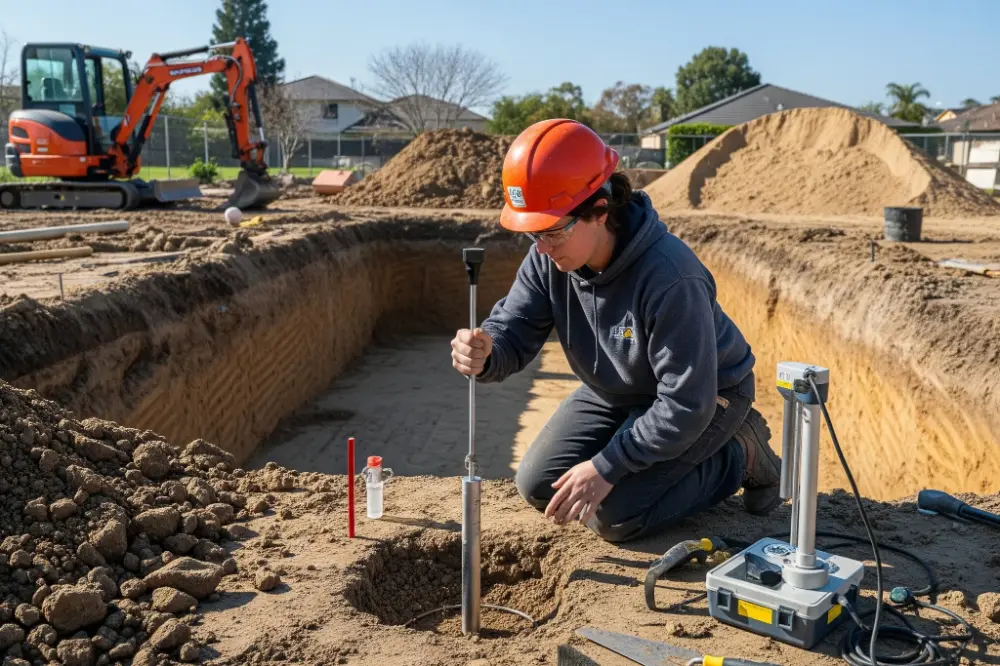
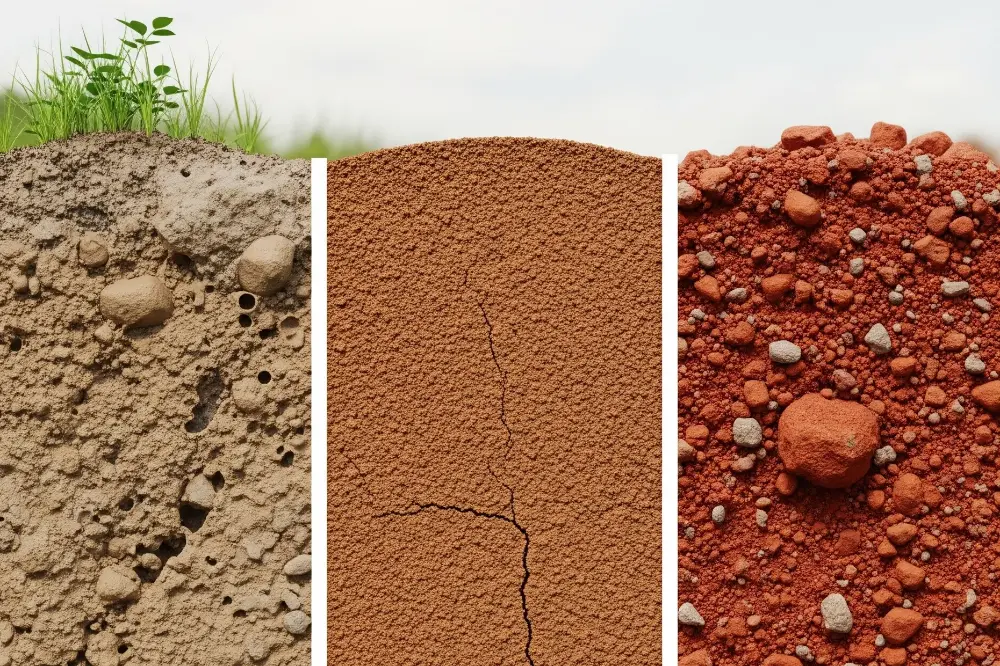
- Soil and Topography Studies
Observe and identify the types of soil present on the site. Also note the slope and contour of the land, which can determine the direction of drainage and the need for compaction. - Determining the Location and Dimensions of the Pool
Ensure that the pool layout has been determined using stakes, measuring tape, and a laser level. This is to ensure that heavy equipment does not stray outside the work zone. - Access and Mobility
Ensure there is sufficient access if using heavy equipment such as excavators or backhoes. Don't forget to check for overhead obstacles, such as power lines, trees, and building structures. - Identify Underground Utilities
Use a utility detector to check for any water pipes, electrical lines, or sewage lines buried underground. - Drainage and Wastewater System Planning
Prepare temporary drainage channels to prevent water from pooling. And ensure that the disposal of excavated soil has been planned so as not to interfere with the work area. - Work Safety
Use personal protective equipment such as helmets, safety shoes, and protective eyewear to minimize the risk of serious workplace accidents. Also pay attention to the safe depth for workers. The safe depth for manual excavation is a maximum of 1.5 m. If it is more than that, temporary wall supports (shoring or slope) must be used to prevent the soil from collapsing. As for heavy equipment, the safe depth is 2-3 m depending on the bucket and soil type. - Legal Documents and Permits
Ensure you have a construction permit before undertaking a project, especially if the project site is near property lines or public utilities.
Conclution
The excavation of the pond must be adjusted to the condition of the land, the design, and the available budget. Manual power is suitable for narrow areas, details, and small scales, while heavy equipment is more efficient for large volumes. However, a combination of both is often the best option as it can save time and costs. In addition, careful planning and soil studies are very important to ensure that the excavation process is safe, fast, and in accordance with specifications.